
West Facing House Vastu Plan

East FACING HOUSE VASTU PLAN
Is your plot facing west? Are you looking for West Facing Vastu Plans? Don’t worry. In this article, we explain everything about a West Facing House Vastu Plan. If you are planning to construct a house on a west-facing plot, this guide can help you design your home according to Vastu Shastra principles.
Vastu Consultant Online
Let us first understand the term West Facing House. If the main entrance or door of a building is located on the western external wall, it is called a West Facing House. This means that when you enter the west-facing home, your face will be towards the eastern side of the building.
A typical picture of a West Facing Vastu Home Plan is shown below. If you need a customized building plan as per Vastu Shastra, you can consult VVipinsir for professional guidance.
Also Read

Rectangular or square-shaped plots are considered ideal for Vastu planning. Trapezoidal plots can also be used with proper Vastu design and planning.
Some popular square-shaped Vastu plot sizes include 30×30, 35×35, 40×40, 45×45, 50×50, 55×55, 60×60, 65×65, 70×70, 80×80, and 90×90.
Examples of rectangular Vastu house plot sizes include 30×40, 40×30, 30×50, 35×50, 40×50, 40×60, 50×60, 50×70, and 40×70. These plot sizes are commonly used for planning Vastu-compliant house designs.
How to Make House Plan For West Facing Plot ?
Are you planning to construct a house on a west-facing plot? If yes, it is important to understand some essential Vastu principles and technical guidelines before starting the design. A west entrance plot or house means that when you enter the building, your face is towards the eastern wall.
In the case of west-facing building plans, a Vastu planner may face slightly more challenges in space utilization and arrangement. However, with proper planning and design, a well-balanced Vastu house can still be achieved.
The basic requirements for planning a house according to Vastu Shastra, regardless of the facing (West, North, East, or South), are accurate direction and precise measurements. Before starting the planning process, all sides of the plot—length and breadth—should be measured carefully. Diagonal or corner measurements are also important to ensure accurate plotting of the land boundary.
Determining the true geographical north is a crucial step in Vastu design. If the direction is incorrect, the entire Vastu planning may become inaccurate. A prismatic magnetic compass can be used to determine the north direction, but it must be handled carefully. An oil-based prismatic compass is often preferred for measuring orientation more accurately. Factors such as local magnetic attraction, nearby electric lines, or iron objects may cause errors in measuring the correct direction, so these should be considered while taking measurements.

Step-by-Step Guide for Building Plan as per Vastu Shastra
For customized Vastu design and planning services, contact our Vastu specialist VVipinsir. Our planner come from a science background, ensuring both technical accuracy and Vastu compliance.
To start the customized design process, you need to share a few basic details such as:
Plot size and dimensions
Google Maps drop point to determine the exact direction
Construction budget
Architectural requirements, including:
Number of bedrooms
Number of floors or stories
Dining and kitchen type
Number of toilets and bathrooms
Garage or car parking requirements
Type of staircase
Requirement for a puja room
Based on your requirements, the Vastu planner will prepare the first sample of your West-facing house plan. The initial design will be shared with you in PDF format.
After receiving the first ground floor plan, you can request 2–3 revisions to customize the layout according to your preferences. The same revision process is also available for the first floor plan, ensuring that the final design perfectly matches your needs and Vastu guidelines.
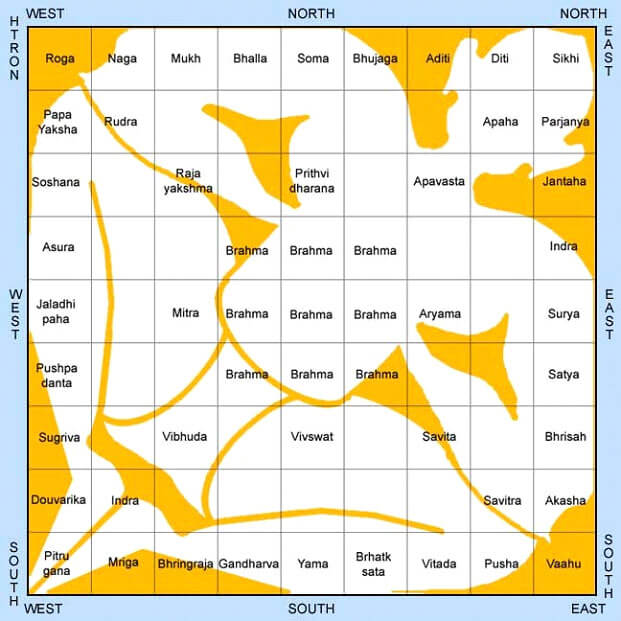
Position Of Main Entrance Of a South Face Building.
The location of the main entrance is one of the most important factors in a west-facing house plan. The main door acts as a connector between the outer energy field and the inner energy field of the home.
Many Vastu experts advise avoiding west-facing houses because the sun sets in the west. However, this is a common Vastu myth. With the proper placement of the main entrance, a west-facing home can also be very auspicious and beneficial.
The exact location of the entrance should be determined by correctly casting the Vastu Purusha Mandala on the built-up area. For a west-facing property, the north-west and south-west zones should be avoided while placing the main door during the layout planning.
In the western side of the Vastu Purusha Mandala, there are eight entrance padas (energy fields). Among these eight, only two padas are considered highly auspicious for the main entrance:
Pushpdant
Sugreev
The Varun pada can also be used to some extent. The remaining energy fields — Pitra, Dwarik, Asur, Shosha, and Papyaksma — are considered inauspicious for placing the main entrance.
For accurate results, the Polar Coordinate System should be used while calculating the position of the main door with respect to the true north direction and Brahma Sthana.
For a west-facing house, the western side of the plot covers 90 degrees of the total circle. According to the Vastu Purusha Mandala, this 90-degree section is divided into 8 equal energy fields (padas).
Step-by-step calculation:
Total degrees of the west portion = 90°
Total number of energy fields = 8
Degrees for each energy field = 90 ÷ 8 = 11.25°
This means each pada or energy field occupies 11.25 degrees on the western outer wall.
For proper Vastu planning, the Whole Circle Bearing (WCB) system is used to measure the exact direction. In a west-facing property, the auspicious range for placing the main door lies between WCB 248° to WCB 270°.
Placing the main entrance within this range helps ensure that the door falls within favorable energy fields, which is considered beneficial according to Vastu principles. For accurate placement, the calculation should always be done using the Polar Coordinate System based on the true geographical north direction.
Vastu For West Facing House Plan
There is a common Vastu myth that west-facing houses are inauspicious, but this is not true. According to Vastu principles, the west direction can bring profit and financial growth if the correct pada (energy field) and planning methods are followed during design and construction.
Indian Vastu Shastra explains detailed principles for house planning, design, measurements, and construction. These principles are described in thousands of Sanskrit slokas, which have been interpreted and applied in modern planning for residential, commercial, and industrial buildings.
Below are some general Vastu guidelines for a West-Facing House Plan:
1. Position of Main Door
The main door or entrance gate of a west-facing house should be located on an auspicious pada of the Vastu Purusha Mandala. For west-facing homes, the most favorable padas are Pushpdant and Sugreev, while Varun can also be considered to some extent. The main entrance should be attractive, well-lit, and free from obstructions. Avoid placing large trees or tee junctions directly in front of the main door.
2. Position of Bedroom
When entering the house from the west side, bedrooms can be planned in the South-West, South, East, North, or North-West zones. These directions are generally considered suitable for bedroom placement in west-facing homes.
3. Kitchen Location
In a west-facing house plan, the kitchen is ideally located in the South-East (Agni zone). Other acceptable locations include South-South-East, South, and North-West zones. The cooking direction should preferably be facing east, which is considered beneficial in Vastu planning.
4. Position of Toilets and Bathrooms
For west-facing homes, suitable locations for bathrooms and toilets include the South of South-West zone and the East of South-East zone. These areas help maintain balance in the Vastu energy distribution of the house.
5. Position of Staircase
The staircase should never be placed in the North-East zone, as this area is considered sacred and light. In duplex houses, stairs can be constructed in the South, South-West, or West zones. The total number of steps should ideally be odd, including the landing.
6. Living Room
The East zone is generally considered the best location for a living room. However, in west-facing homes, the western side or central portion of the built-up area can also be used effectively for the living room.
7. Puja Room
The most auspicious place for a puja room is the North-East (Ishaan) zone. If this space is not available, alternative locations include the West, East, or North zones. While praying, the person should ideally face east.
8. Study Room
If a study room is required, it can be placed in the North-East zone or the west of the South-West zone, which are considered supportive for focus and learning.
Avoid These Mistakes During West-Facing House Planning
Many so-called Vastu experts prepare house plans using incorrect methods. They often take inaccurate directions and improper scaling while preparing layouts. However, Indian Vastu Shastra is completely based on geometry, and its principles can only be applied correctly when proper geometrical calculations and measurements are used.
The true geographical north direction and accurate dimensions through scaled drawings are the most important inputs for correctly casting the Vastu Purusha Mandala on your plot. If these two elements are incorrect, the entire Vastu planning can become inaccurate.
In many cases, house maps are copied blindly without verifying the actual direction of the plot. For example, in some designs the North–South line may have an inclination, such as a 14-degree shift towards the east, but people still use the same plan without adjusting the orientation for their own land. This results in incorrect Vastu implementation during construction.
Another common mistake made by many online and offline planners is using the Cartesian coordinate system for casting the Vastu Purusha Mandala. In professional Vastu planning, the Polar Coordinate System is considered more suitable because it works accurately even for irregular plots or plots with an inclined North–South axis.
Therefore, always verify the actual direction, proper measurements, and correct calculation methods before finalizing a Vastu house plan to avoid costly mistakes during construction.